
| Points | 30 |
| Due | March 23, 2023 |
For quiz #2, focus on the following portions of your book by Wenham/Walton:
- Read Chapter 1
- skip chart on p. 8-9
- Read Chapter 4
- skip p. 68-73
- skip p. 80-83…
- Read carefully p. 85 (~173?), especially what Dunn says
- Read Chapter 11 (all).
About 1/3 of your quiz will be on the readings and about 2/3 on the lectures.
My article on the Jubilee Mission of Jesus in Luke is only necessary if you want to review the material in the lecture and go deeper with it. It’s up to you whether you read it.
Exploring the New Testament
Chapter 1
The historical context of Jesus and the New Testament
- Sources
- Intertestamental period
- Roman until AD 70
- Key ingredients for Jesus’ context
Persian period → Jewish War
- Sources
- Old / New Testaments
- Jewish sources - second temple period (538BC - AD 70)
- Maccabees - first book is the most valuable - pro-Jewish, pro-Maccabean viewpoint
- Setup of Abomination of desolation - 167 BC
- Josephus (AD 37 - 100)
- Dead Sea Scrolls (1947)
- 11 caves
- 1QS - Community Rule
- 1QH - Hymn Scroll
- 1QM - War Scroll
- Other Jewish sources
- Apocrypha
- Pseudepigrapha - 1 Enoch
- Philo of Alexandria
- Mishnah (AD 200) & Talmud (AD 400)
- Targums
- Greek and Roman historians
- Before the Romans
- Few returned from Babylonia
- Some went to Egypt
- Rebuilding was slow
- Mistrust of the Samaritans - built the own temple on Mount Gerizim (4th century BC)
- The Greeks
- Philip, king of Macedonia united kingdom of Greece
- Alexander 336 BC conquests
- NT synagogues worship in Greek (tensions with Aramaic speaking Christians)
- Ptolemies (like Persians) lenient, hands-off approach toward the Jews, relative freedom and autonomy
- Seleucids were punitive
- Maccabees vs Seleucid Empire
- Antiochus 4 (175 - 163 BC) “Epiphanes”
- Installed illegitimate high priests (Jason & Menelaus)
- Attacking Jerusalem, looting the temple
- Rededicated the temple to Olympian Zeus (desolating sacrilege) from 167 - 164 BC.
- Hasmoneans priestly family resisted
- Mattathias refused to offer sacrifice
Let everyone who is zealous for the law and supports the covenant come out with me! (1 Macc. 2:27)
- Judas (Maccabeus “hammer”) attacked the Seleucid forces
- Rededication of the temple in 164 BC
- Hanukkah - John 10:22
- Jesus’ use of “The desolating sacrilege” when referring to future disaster coming on Jerusalem (Mark 13:14)
- Paul’s “man of lawlessness” setting himself up in the temple (2 Thess 2)
- Antiochus 4 (175 - 163 BC) “Epiphanes”
- Hasmonean Dynasty
- Simon achieved freedom from Seleucid taxation for Judea
- Hyrcanus 1 (son of Simon) conquered Samaria, Idumea, part of Galilee
- Destruction of Samaritans’ temple in 128 BC caused a rift
Key Dates
From the OT to the Roman takeover
| BC | Event |
|---|---|
| 538 | Release of Jews (Cyrus the Persian) |
| 336 | Alexander becomes king of Macedonia |
| 323 | Alexander died - Ptolemy empire capital Alexandria in Egypt |
| 312 | Seleucus found Seleucid empire capital Antioch in Syria |
| 198 | Palestine, which until nw was part of the Ptolemaic empire, is taken over by the Seleucids after batter at Paneion |
| 190 | Seleucid king, Antiochus 3, defeated by Romans at Lydia and forced to make large payments to Rome |
| 167 | Antiochus 4 sets up pagan altar, “the desolating sacrilege”, in Jerusalem temple and tries to eradicate Jewish religion |
| 164 | Temple rededicated after successful campaign by Judas Maccabeus, from the Hasmonean family |
| 160 | Judas killed, and his brother Jonathan takes over |
| 152 | Jonathan accepts position of high priest, though not himself from Zadokite high-priestly family |
| 143 | Jonathan killed and succeeded by his brother Simon, who soon achieves freedom from taxation for Judea |
| 134 | Simon assassinated; succeeded by his son Hyrcanus 1 |
| 128 | Hyrcanus’ forces destroy Samaritan temple on Mount Gerizim |
| 104 | Aristobulus 1 succeeds his father Hyrcanus; conquers Galilee |
| 103 | Aritobulus dies suddenly, and is succeeded by his brother Alexander Janneus, who greatly expands territory, and takes title king of Judea |
| 76 | Alexander dies, and is succeeded by his wife Alexandra, who favours the Pharisees (whom her husband has oppressed) |
| 63 | Pompey and the Romans take over Jerusalem |
Hasmonean Leaders of Judea 167-63 BC
| BC | Event | Relationship |
|---|---|---|
| 167 | Mattathias | |
| 166 | Judas | son |
| 160 | Jonathan | brother |
| 143 | Simon | brother |
| 134 | Hyrcanus 1 | son |
| 104 | Aristobulus 1 | son |
| 103 | Alexander Janneus | brother |
| 76 | Alexandra | wife |
| 67 | Hyrcanus 2 and Aristobulus 2 | sons |
The Romans
- Pompey entered Holy of Holies in 63 BC caused offense
- Hyrcanus 2 was given authority to rule Jerusalem under Romans
- Roman Historians
- Tacitus (~56-120) Annales, Historiae (Christians as a “deadly sect”)
- Suetonius (~75-150) The Lives of Twelve Emperors (Caesar to Domitian)
- Herod family
- Antipater (Herod the Great)
- Edomite (Idumean)
- Ingratiate himself with the Romans (aid to Julius Caesar)
- Assassinated (as Caesar)
- Herod - help from Romans fought into Jerusalem
- 37 BC - 3 months siege of Jerusalem
- Ruled until 4 BC (king of all Judea, Samaria and Galilee)
- Insecurity - political and psychological
- Executed his father-in-law, wife Mariamme, 3 sons
- Police state, fear
- Augustus might not have said
It is better to be Herod’s pig than his son
- Murderous character (Matt 2:2)
- Famous for buildings
- Jerusalem 19 BC
- Main part took 10 years to complete
- Whole work was done in AD 63
- Josephus speaks of 18,000 employed to build
- 500 yards long, 325 yards wide
- Execution of John Baptist
- Herod died in 4 BC
- Archelaus - brutal, meddle in temple affairs.
- Removed by the Romans in AD 6 (Mat 2:22).
- Direct Roman rule
- Herod Antipas - ruled Galilee AD 39
- Built magnificent city Tiberias
- Sensitive to Jewish feelings
- Married his brother’s wife Herodias
- Deposed from office and exiled in France
- Archelaus - brutal, meddle in temple affairs.
- Caiaphas AD 18-36
- Antipater (Herod the Great)
- Pontius Pilate
- Appointed AD 26
- Protege of Sejanus - anti-Jewish tendencies
- Caesar standard objections
Leaders/Rulers of Judea in the Roman Period
| Date | Ruler | Office |
|---|---|---|
| 55 BC | Antipater | HF |
| 40 BC | Herod the Great | HF |
| 4 BC | Archelaus | HF |
| AD 6 | Coponius | Gov |
| AD 9 | Marcus Ambivius | Gov |
| AD 12 | Annius Rufus | Gov |
| AD 15 | Valerius Gratus | Gov |
| AD 26 | Pontius Pilate | Gov |
| AD 37 | Marullus | Gov |
| AD 41 | Herod Agrippa 1 | HF |
| AD 44 | Fadus | Gov |
| AD 46 | Tiberius Alexander | Gov |
| AD 48 | Cumanus | Gov |
| AD 52 | Felix | Gov |
| AD 59 | Festus | Gov |
| AD 62 | Albinus | Gov |
| AD 64 | Florus | Gov |
Roman Leaders/Emperors
| Date | Ruler | Notes |
|---|---|---|
| c. 60 BC | Pompey, Julius Caesar, Crassus | |
| 49 BC | Julius Caesar | |
| 44 BC | Antony and Octavian | Later Augustus |
| 31 BC | Augustus | First emperor |
| AD 14 | Tiberius | |
| AD 37 | Gaius Caligula | |
| AD 41 | Claudius | |
| AD 53 | Nero | |
| AD 68 | Galba | |
| AD 69 | Otho, Vitellius, Vespasian |
After Pilate
- Marullus (AD 37-41)
- Gaius Caligula setups a statue of himself in the Jerusalem temple
- Another “desolating sacrilege”
- Gaius was assassinated
- Agrippa (AD 41-44)
- Pius, popular with the Jews
- Against the Christians (Acts 12:1-2)
- Fadus (AD 44-46)
- Beheaded a prophet called Theudas
- Felix (AD 52-60)
- Ruthless
- “Sicarii” assassins
Key Dates in the Roman Period
| Date | Event |
|---|---|
| 63 BC | Judea becomes part of the Roman empire |
| 55 BC | Antipater (father of Herod the Great) given the title “procurator of Judea” |
| 44 BC | Julius Caesar murdered in Rom; Antipater murdered a year later |
| 37 BC | Herod the Great captures Jerusalem, named king of Judea by the Romans |
| 19 BC | Renovation of Jerusalem temple begun |
| 4 BC | Jesus’ birth. Herod dies, succeeded by Archelaus in Judea and Samaria (until AD 6), Antipas in Galilee and Perea (until AD 39), Philip in area north of Galilee (until AD 33) |
| AD 6 | Judea and Samaria put under direct Roman rule. Quirinius governor of Syria conducts census, provoking revolt led by Judas the Galilean |
| AD 26 | Pontius Pilate governor of Judah until AD 36 |
| AD 31 | Approximate date of Jesus’ crucifixion and resurrection |
| AD 39 | Roman emperor Gaius orders a statue of himself to be set up in Jerusalem temple |
| AD 41 | Gaius assassinated. Herod Agrippa 1 appointed king of Judea, until his sudden death in AD 44 |
| AD 49 | Claudius, emperor, banishes jews from Rome for rioting at the instigation of “Cherestus”. Many people killed in Jerusalem, due to incident involving Roman soldier |
| AD 52 | Cumanus governor of Judah removed from office for poor handing of Jews and Samaritans. Succeeded by Felix, who has difficulties with Jewish nationalists including “sicarii” |
| AD 59 | Festus governor |
| AD 62 | Festus dies. High priest Annas 2 has James, brother of Jesus, killed, before arrival of new governor Albinus |
| AD 64 | The great fire in Rome, and persecution of Christians. Florus governor of Judea |
| AD 66 | Jewish revolt begins in Jerusalem |
| AD 70 | Jerusalem finally overrun after siege and bitter resistance |
Jesus’ context
- Living under a pagan super-power
- Rich and poor - gap widen
- A new desolating sacrilege
- Maintaining the traditions - sensitive to
- OT law
- separate clean from unclean
- temple
- Longing for change
- Religious confusion and division
- Modern parallels?
Chapter 4
Where did the Gospels come from?
- how scholars analyze the processes by which the Gospels were composed
- how to use a Gospels synopsis as a tool to study the Gospels for yourself
Luke 1:1-4
1 Inasmuch as many have undertaken to compile a narrative of the things that have been accomplished among us, 2 just as those who from the beginning were eyewitnesses and ministers of the word have delivered them to us, 3 it seemed good to me also, having followed all things closely for some time past, to write an orderly account for you, most excellent Theophilus, 4 that you may have certainty concerning the things you have been taught.
- Oldest source is eyewitness testimony (v. 2)
- Source criticism
- Agreements - how they tell a story (same words, closeness, copy?)
- Agreement in the sequence of the stories
- Differences of wording
- Differences of sequence
-
The “two source” hypothesis. Q (German Quelle, meaning “source”) which Mark did not have access.
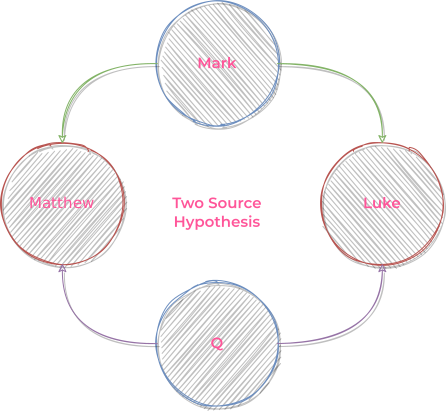
- Markan priority
- Length - shortest 661 verses
- 601 parallel in Mathew and/or Luke
- 97% words found in Matthew
- 88% words found in Luke
- Mark stresses Jesus’ teaching and activities, resurrection account
- Can’t be abridgement of other gospels because of the greater details
- Agreements in the sequence of stories
- Mark + Matthew against Luke
- Mark + Luke against Matthew
- Matthew + Luke never agree in order against Mark
- Grammar & style
- Rougher, working in Greek as 2nd language
- Mt & Lk has smoother style
- Uses Aramaic words which others omit
- Uses slang for “bed” (Greek krabatton 2:4), Mt & Lk uses refined terms (klines Mt 9:2; klinidion Lk 5:19)
- Makes more sense that Lk & Mt changes Mark rather than the other way around
- “Harder” wordings
- Limits Jesus’ power & influence
- 1:34 Jesus heals “many” whereas Mt 8:16 & Lk 4:40 “all” or “every one of them”
- 6:5f “could not” whereas Mt 13:58 “did not” because of unbelief suggests Jesus could but chose not to
- 10:14 “Indignant” with them (James & John) but Mt 20:20 has their mother asked, “cover” some of the disciples’ failings?
- Theology
- Matthew uses “Lord” more to heightened Christology
- Length - shortest 661 verses
-
Q (Quelle in German)
235 verses which Matthew & Luke share and Mark does not have
-
Agreements in wording
John the Baptist’s preaching Mt 3:7-10 & Lk 3:7-9
- Agreements in sequence
-
“Doublets”
Triplets those who have will receive more (Mt 13:12; Mk 4:25; Lk 8:18)
- The Beatitudes
- The Salt of the earth
- The Light of the world
- The Law and prophets
- On Reconciliation
- On Adultery and divorce
- On Retaliation
- On Love for enemies
- The Lord’s prayer
- On treasure in heaven
- Good eyes
- On serving two masters
- On anxiety
- On judging others
- On answers to prayer
- The golden rule
- The two ways
- A tree and its fruit
- Obedience, not words only
- The two builders
-
Coherence
Q material forms a coherent body with quite a consistent theological perspective
-
- Criticisms of the two source hypothesis
- Relationships are not straightforward, data doesn’t fit neatly in the two source hypothesis
- Priority of Mark, omission of the substantial section (Mk 6:45-8:26) by Luke is surprising (giving closely following sequence)
- Matthew & Luke agree in wording against Mark (Mt 3:11f; Mk 1:7f; Lk 3:16-18) harder to explain, meaning Matthew & Luke independently changed Mark’s phrase to exactly different phrase
- Mark Goodacre criticizes parallel between Q and Gospel of Thomas
-
Q is better explained by Farrer-Goulder view that Mark writes first, Luke writes last, using both Mark & Matthew
- Mark → Matthew → Luke
- Mark → Luke
- Speculations that there might be multiple “editions” of Q because of inconsistent doublets (Lk 19:12-27 cf. Mt 25:14-30)
- Stories appear in both Mark & Q (overlap)
- John the Baptist
- Temptation of Jesus
- Jesus colluded with Satan
- Mustard seed
- Commissioning the disciples
- Exact wordings of these stories. Mark & Q agree verbatim in 50 verses. Harder to conclude that Q is an independent source (is it Mark?)
-
- The Griesbach (or “two Gospels”) hypothesis
-
W.R Farmer → Matthew wrote first, then Luke used Matthew and Mark made a short version of the two longer Gospels (originated from J.J. Griesbach)
- Matthew → Luke → Mark
- Matthew → Mark
-
Early testimony
Irenaeus, Eusebius & Augustine consider Matthew to be the first Gospel
-
Matthew’s Jewishness
Assumes washing customs because predominantly Jewish until became more Gentile
- Agreements in order and wording
- If Mt & Mk agree against Lk, Mk has followed Mt rather than Lk
- If Lk & Mk agree against Mt, Mk has followed Lk rather than Mt
- If Mt & Lk agree against Mk, Mk deviates from both of his sources
- Markan redundancies
- Over 200 places in Mark
- Incorporating both phrases
- The “minor agreements”
-